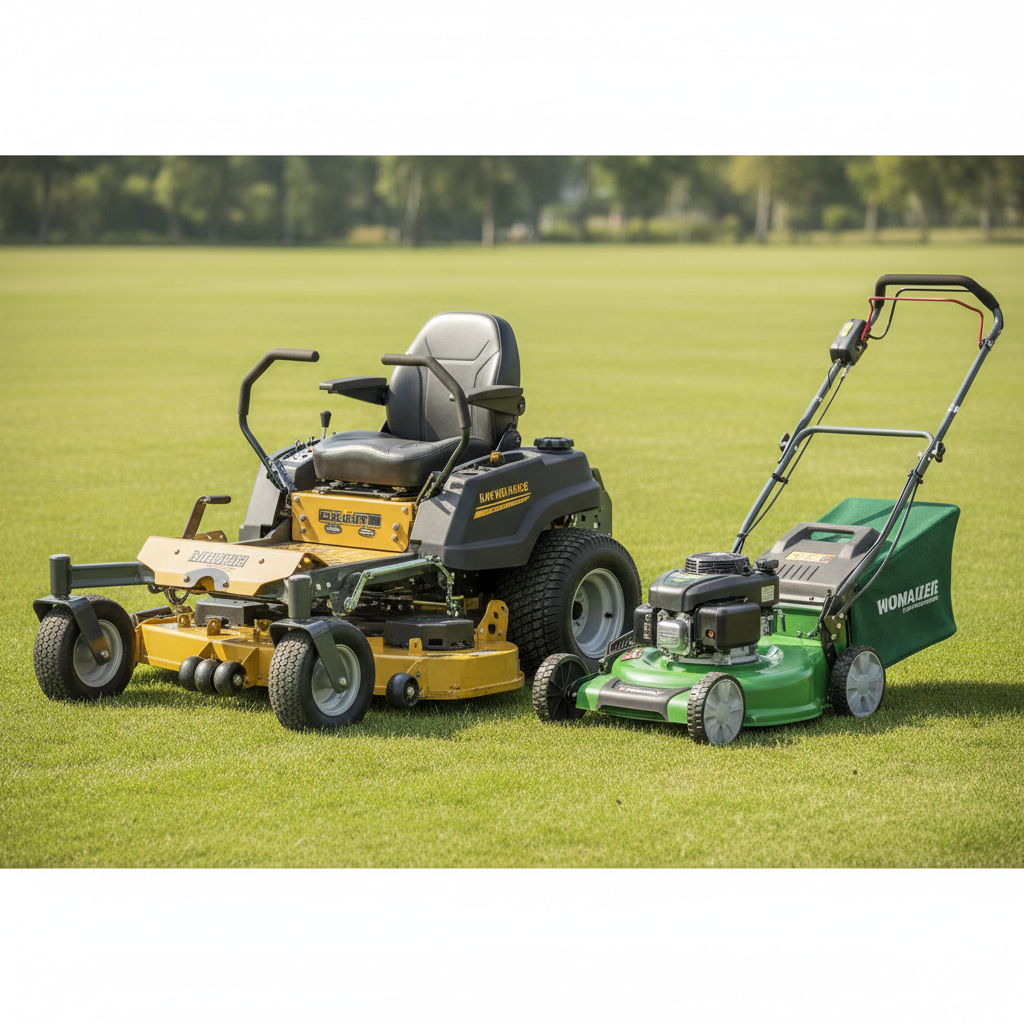
The honest answer: A commercial mower costs 2–4× more than a residential model — and for most homeowners, that premium is completely unjustified. But for landscapers, large property owners, and anyone mowing more than 4 hours per week, the commercial machine pays for itself in longevity, productivity, and avoided repair costs. Here's exactly how to know which category you fall into.
The Core Difference: Duty Cycle
The fundamental distinction between commercial and residential mowers isn't brand, color, or even price — it's duty cycle. Duty cycle refers to how many hours per day, days per week, and years of service a machine is designed to handle before requiring major maintenance or replacement.
A residential mower is engineered for light use: 1–3 hours per week, 30–40 weeks per year, for 5–10 years. That's roughly 150–400 total hours of engine life before the machine is typically retired. Residential machines are designed to be affordable, not indestructible.
A commercial mower is engineered for sustained heavy use: 6–10 hours per day, 5–6 days per week, for 10–15 years. That's 2,000–5,000+ total hours of engine life. Every component — the frame, engine, spindles, hydrostatic transmission, and deck — is built to a higher specification to survive that workload. In South Florida's year-round mowing season, commercial machines earn their premium faster than anywhere else in the country.
Head-to-Head Comparison
Commercial vs. Residential — Key Specifications
| Specification | Commercial | Residential |
|---|---|---|
| Engine Life (hours) | 2,000–5,000+ | 300–600 |
| Frame Construction | 7–10 gauge steel | 12–16 gauge steel |
| Deck Thickness | 7 gauge (0.187") | 10–13 gauge (0.134"–0.100") |
| Spindle Bearings | Heavy-duty sealed, field-replaceable | Light-duty, often non-serviceable |
| Hydrostatic Transmission | Commercial-grade (Parker, Hydro-Gear ZT-5400) | Residential-grade (Hydro-Gear EZT, Tuff Torq) |
| Engine Options | Kawasaki FX, Kohler EFI, Vanguard | Briggs & Stratton, Kawasaki FR, Kohler 7000 |
| Cutting Width | 48"–72" | 30"–54" |
| Warranty | 2–4 years commercial use | 2–3 years residential use |
| Price Range (zero-turn) | $8,000–$18,000+ | $2,500–$5,500 |
| Typical Service Interval | Every 50–100 hours | Every 50 hours or annually |
Breaking Down the Key Differences
Frame Gauge and Weld Quality
Commercial mower frames are fabricated from 7–10 gauge steel — roughly twice the thickness of residential frames. More importantly, commercial frames use full-penetration welds at stress points rather than the tack welds common on residential machines. In South Florida, where landscapers are loading and unloading mowers from trailers multiple times per day, frame integrity is critical. We've seen residential frames crack at the deck lift pivot after just two seasons of commercial use. Commercial frames routinely last 15+ years under the same conditions.
Engine Quality and Repairability
Commercial engines — Kawasaki FX series, Kohler Command Pro EFI, Briggs & Stratton Vanguard — are designed for high-hour operation and field repairability. Parts are widely available, service intervals are well-documented, and engines can be rebuilt rather than replaced. Residential engines like the Kawasaki FR series or Kohler 7000 are excellent for their intended use but are not designed for 2,000+ hour operation. They're also harder to source parts for as they age. For commercial use, always specify a commercial-grade engine.
Deck Construction and Spindle Bearings
The cutting deck takes more abuse than any other component. Commercial decks use 7-gauge steel that resists impact damage from rocks, roots, and debris. Spindle housings are cast iron or heavy-gauge steel with large, field-replaceable bearings. When a spindle bearing fails on a commercial machine, you replace the bearing ($15–$30) and keep mowing. On many residential machines, the spindle assembly is a sealed unit that must be replaced entirely ($80–$150) — and may not be available after 5–7 years.
Hydrostatic Transmission
The hydrostatic transmission is the most expensive component to replace on a zero-turn mower. Commercial machines use heavy-duty units like the Parker TG series or Hydro-Gear ZT-5400, rated for 2,000+ hours of commercial use. Residential machines use lighter units like the Hydro-Gear EZT or Tuff Torq K46, which are adequate for residential use but can fail prematurely under commercial loads. A commercial hydro replacement costs $600–$1,200 per side — but it's a repair that commercial machines rarely need before 2,000 hours. Residential hydros often need attention at 400–600 hours of commercial use.
Cut Quality and Productivity
Commercial mowers produce a noticeably better cut quality due to higher blade tip speed, more precise deck leveling systems, and better blade engagement mechanisms. For homeowners, this difference is subtle. For landscapers billing clients for professional results, it's significant. Commercial decks also offer wider cutting widths (60"–72" vs. 48"–54" on residential), which directly impacts productivity. A 60" commercial zero-turn can mow an acre in 20–25 minutes. A 48" residential machine takes 35–40 minutes for the same acre.
Who Should Buy Commercial?
Use this decision framework to determine which tier is right for your situation:
Buy Commercial If You Are:
- →A landscaping contractor mowing multiple properties daily
- →A property manager maintaining 2+ acres regularly
- →A homeowner with 3+ acres mowing weekly year-round
- →Anyone mowing more than 4 hours per week
- →A municipality, HOA, or commercial property owner
- →Someone who needs a machine to last 10+ years
Buy Residential If You Are:
- →A homeowner mowing your own property only
- →Mowing less than 2 hours per week
- →Working with a lot under 1.5 acres
- →On a budget and mowing infrequently
- →Not planning to use the machine commercially
- →Looking for a machine for 5–8 years of light use
The "Prosumer" Middle Ground
There's a growing category between residential and full commercial: prosumer machines. These are residential-grade machines with commercial-grade engines and upgraded components. Examples include the Hustler Raptor XD, Toro TimeCutter with MyRIDE suspension, and SCAG Freedom Z.
Prosumer machines typically cost $4,500–$7,000 and are ideal for homeowners with large lots (1.5–3 acres) who want better durability than a standard residential machine without the full commercial price tag. They're not appropriate for commercial landscaping use — the frames and transmissions aren't rated for daily commercial loads — but they're an excellent value for demanding residential use.
In our showroom, prosumer machines are our most popular category for Palm Beach County homeowners with larger lots. The Hustler Raptor XD in particular has been a strong seller — it uses a Kawasaki FR engine, a 10-gauge fabricated deck, and a Hydro-Gear ZT-2800 transmission that outperforms most residential machines while staying under $6,000.
Total Cost of Ownership: The Real Math
The sticker price difference between commercial and residential is significant, but total cost of ownership tells a different story — especially for high-use applications.
10-Year Cost of Ownership — Commercial Landscaper (40 hrs/week)
| Cost Factor | Commercial ($12,000 machine) | Residential ($4,000 machine) |
|---|---|---|
| Initial Purchase | $12,000 | $4,000 × 3 replacements = $12,000 |
| Annual Maintenance | $400/yr × 10 = $4,000 | $600/yr × 10 = $6,000 |
| Major Repairs (10 yrs) | $1,500 (spindles, belts) | $3,000+ (transmissions, engines) |
| Downtime Cost | Low — parts available, durable | High — frequent breakdowns |
| Resale Value (10 yrs) | $2,000–$4,000 | $0 (worn out) |
| Total 10-Year Cost | ~$15,500 (net of resale) | ~$21,000+ |
* Estimates based on typical commercial landscaping use in South Florida. Actual costs vary by brand, maintenance practices, and operating conditions.
Commercial Brands We Carry at Palm Beach County Mowers
We stock and service the top commercial brands trusted by landscapers across Palm Beach County:
Hustler Turf
Super Z, Super Z HyperDrive, Raptor XD
Our top-selling commercial brand. The Super Z HyperDrive is the fastest commercial zero-turn available — up to 16 mph. Exceptional for large commercial properties.
SCAG Power Equipment
Tiger Cat II, Cheetah II, Turf Tiger II
The benchmark for commercial zero-turn durability. SCAG machines are the most common brand on professional landscaping trailers in Palm Beach County.
Toro Commercial
TITAN MAX, Z Master 6000/7000 Series
Toro's commercial line offers excellent cut quality and a wide dealer network for parts support. The Z Master 7000 is popular with municipal and HOA accounts.
Honda Commercial
HRC216, HRX217 (walk-behind)
Honda's commercial walk-behinds are the gold standard for small-lot commercial use. The HRC216 is used by professional landscapers worldwide for its reliability and cut quality.
Questions to Ask Before You Buy
When you visit our showroom, our sales team will walk you through these questions to help you find the right machine:
- How many hours per week will this machine run? (Under 4 hrs = residential, 4–8 hrs = prosumer, 8+ hrs = commercial)
- How many acres will you be mowing per week total?
- Will this machine be used on multiple properties or just your own?
- What's your budget — and are you open to financing?
- Do you have a dealer nearby for parts and service? (Critical for commercial machines)
- What terrain are you mowing — flat, sloped, obstacles?
- Do you need a bagging system, mulching kit, or striping roller?
- What's your timeline for ROI if buying commercial?
Come See Both Side-by-Side
Our Boca Raton showroom has commercial and residential machines on the floor. Our sales team — not commission-driven order-takers — will give you an honest recommendation based on your actual use case. We also offer financing through Sheffield Financial and GreenSky for qualified buyers.