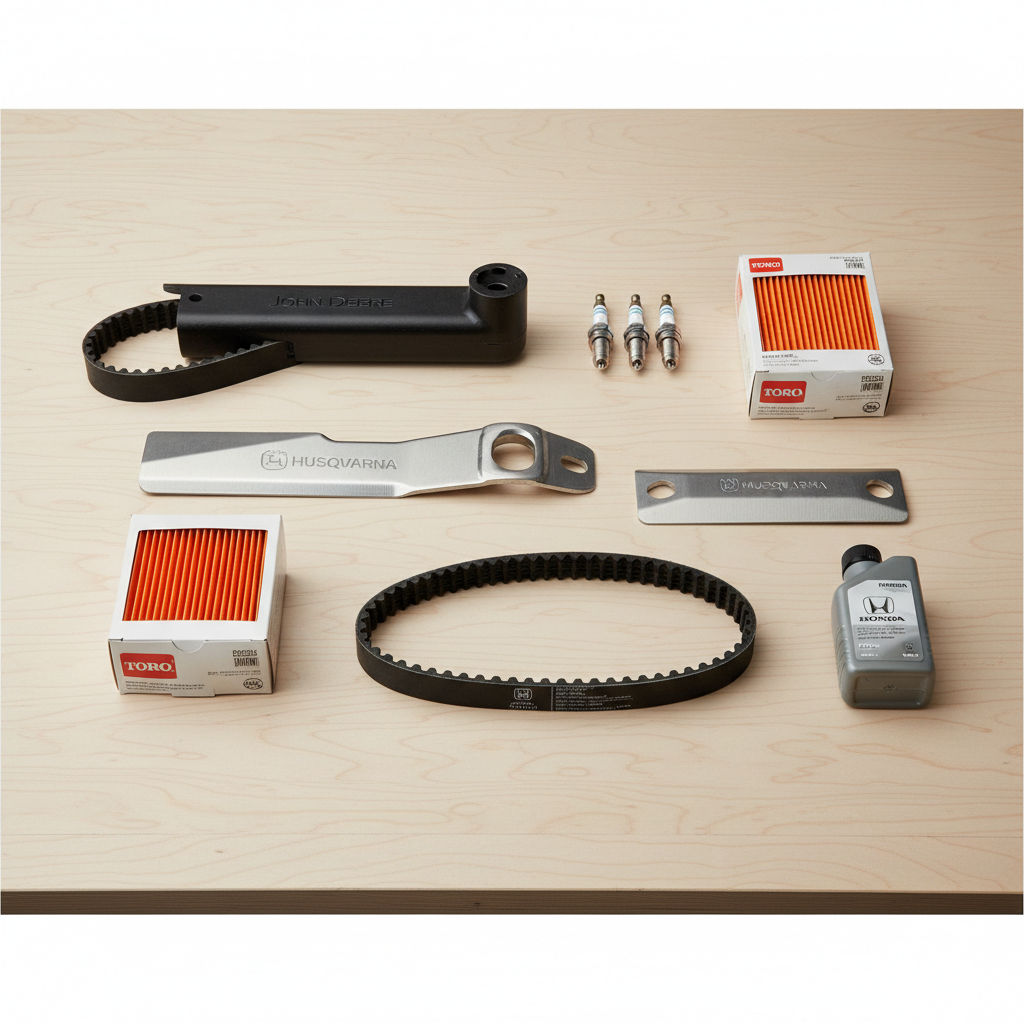
The real cost of "saving" $20: In over 20 years of repairing lawn equipment in Palm Beach County, we've seen the same story play out hundreds of times. A customer buys a cheap aftermarket belt, air filter, or blade online. It fails in 30 days. They bring the mower in. We replace the part with OEM — and often repair secondary damage caused by the failed aftermarket component. The "savings" cost them three times as much.
What Does "OEM" Actually Mean?
OEM stands for Original Equipment Manufacturer. An OEM part is made by — or to the exact specifications of — the company that built your mower. When Hustler Turf designs a drive belt for the Raptor series, that belt is engineered to specific tolerances: exact width, thickness, material composition, and tensile strength. Every dimension is calculated to work with the specific pulleys, deck geometry, and engine output of that machine.
An aftermarket part is made by a third party who has reverse-engineered the original. They measure the original part, approximate its dimensions, and manufacture it at a lower cost — usually by using cheaper materials, looser tolerances, or simplified construction. The part may look identical. It may even fit. But the performance and longevity are rarely equivalent.
The 5 Parts Where OEM vs. Aftermarket Matters Most
1Drive Belts
OEM Advantage
OEM belts are made to exact length, width, and compound specifications. The rubber compound is formulated to handle the specific heat and flex cycles of your machine.
Aftermarket Risk
Aftermarket belts are often slightly off in length or width. Even 1/16" difference causes slippage, premature wear, and heat buildup. We've seen aftermarket belts fail in under 20 hours of use.
Real Cost Comparison
OEM belt: $35–$65. Aftermarket: $12–$25. Secondary damage from a failed belt: $150–$400.
2Air Filters
OEM Advantage
OEM air filters are tested to filter particles down to the exact micron rating the engine requires. The filter media density, frame seal, and housing fit are all engineered together.
Aftermarket Risk
A filter that doesn't seal perfectly allows unfiltered air into the engine. In South Florida's sandy environment, even small amounts of abrasive particles cause accelerated cylinder and piston wear.
Real Cost Comparison
OEM filter: $15–$30. Aftermarket: $5–$12. Engine rebuild from sand ingestion: $800–$2,500+.
3Spindle Bearings
OEM Advantage
OEM spindle bearings are rated for the exact RPM, load, and temperature range of your deck. They're sealed and lubricated to the manufacturer's specification.
Aftermarket Risk
Undersized or under-rated bearings fail under the high RPM loads of commercial mowing. A failed spindle bearing can destroy the spindle housing, requiring a complete spindle assembly replacement.
Real Cost Comparison
OEM bearing: $20–$45. Aftermarket: $8–$18. Spindle assembly replacement: $200–$500.
4Blades
OEM Advantage
OEM blades are made from specific steel alloys, heat-treated to the correct hardness, and balanced to tight tolerances. The lift angle and cutting edge geometry are optimized for the deck design.
Aftermarket Risk
Softer steel dulls faster. Incorrect lift angle reduces airflow and cut quality. An unbalanced blade causes vibration that damages spindle bearings and deck welds over time.
Real Cost Comparison
OEM blade: $25–$55. Aftermarket: $10–$20. Spindle damage from unbalanced blade: $150–$400.
5Fuel Filters and Carb Kits
OEM Advantage
OEM fuel filters are rated for the exact flow rate and filtration level your carburetor requires. OEM carb rebuild kits include all gaskets, needles, and jets made to original spec.
Aftermarket Risk
A fuel filter with incorrect flow restriction causes lean running and engine damage. Aftermarket carb kits often include gaskets that don't seal properly, leading to air leaks and rich/lean conditions.
Real Cost Comparison
OEM carb kit: $25–$60. Aftermarket: $8–$20. Carburetor replacement: $80–$250.
When Aftermarket Parts Are Acceptable
We're not saying aftermarket parts are always wrong. There are situations where they make sense:
- The OEM part is discontinued and no longer available
- The machine is very old and not worth the cost of OEM parts
- The aftermarket part is from a reputable brand (Oregon, Stens, Rotary) with a known quality track record
- It's a non-critical consumable like a spark plug or oil filter where quality differences are minimal
The key is knowing which parts are critical and which aren't. Drive belts, spindle bearings, blades, and fuel system components are critical. Deck wash ports, cup holders, and seat cushions — not so much.
How to Identify Genuine OEM Parts
Buy from an Authorized Dealer
Authorized dealers like Palm Beach County Mowers receive parts directly from the manufacturer. Counterfeit parts are a real problem on online marketplaces.
Check the Part Number
Every OEM part has a manufacturer part number. Cross-reference it with the manufacturer's parts diagram for your specific model.
Look for Brand Markings
Genuine OEM parts typically have the manufacturer's logo or part number molded or stamped into the part itself.
Be Wary of "OEM Compatible"
"OEM Compatible" or "Fits OEM" does NOT mean it's an OEM part. It means it's an aftermarket part designed to fit. Read carefully.
Warranty Implications
Using non-OEM parts can void your manufacturer's warranty. Most mower warranties include language stating that damage caused by non-approved parts is not covered. If your Hustler or Exmark is still under warranty, using aftermarket parts for a repair could leave you responsible for the full cost of any subsequent warranty claim — even if the aftermarket part wasn't the direct cause of the new failure. Our advice: always use OEM parts on any machine still under warranty.
Shop Genuine OEM Parts
Palm Beach County Mowers stocks OEM parts for Hustler, Exmark, Toro, Scag, Ferris, Gravely, and more. If we don't have it in stock, we can order it — usually next-day delivery.
Shop OEM Parts →